TERN and Swarmbotics Partner to Advance Resilient Autonomy for U.S. Army Ground Operations
As the Army increases its focus on autonomy, this successful integration enables more resilient autonomous and swarm operations in denied environments
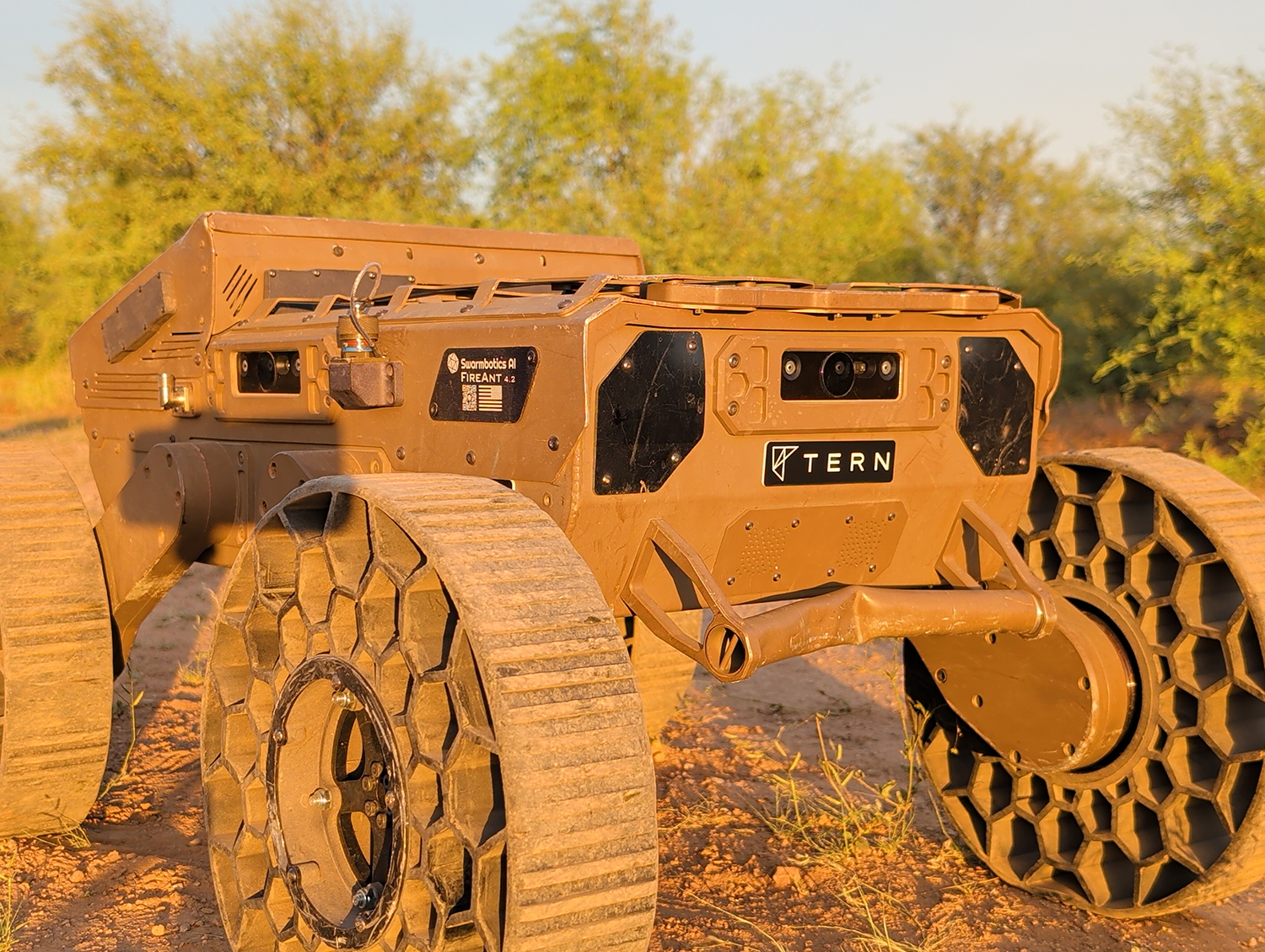
TERN and Swarmbotics have integrated TERN’s Independently Derived Positioning System (IDPS™) into Swarmbotics’ FireAnt autonomous ground platform, giving the autonomy stack a resilient source of position even in total GNSS denial. The successful integration, marking TERN’s expansion into autonomy, establishes the technical foundation for a broader partnership between the companies.
The partnership directly supports the Army’s push to scale autonomy across its formations. Earlier this month, the Army established the U.S. Army Futures and Autonomous Systems Command and designated a Portfolio Acquisition Executive for Autonomy, while the Department of War announced an Autonomous Warfare Command. Together, these moves place operational leadership, acquisition and force design behind the effort to field autonomy across the Joint Force.
The challenge now is scale. Bringing autonomy into ground formations requires affordable systems that can be fielded in numbers and continue operating when GNSS is contested or denied. Swarmbotics provides the autonomous, modular ground platform and swarm orchestration architecture. TERN provides the resilient, vehicle-derived position those systems need to operate in DDIL and complex environments. By making resilient positioning part of the autonomy stack, the TERN-Swarmbotics integration helps close the gap between autonomous capability and sustained autonomous operations.
Swarmbotics pairs FireAnt, a fully autonomous, modular, man-portable unmanned ground vehicle, with ANTSNet, its swarm orchestration and command & control solution. The integrated system allows one operator to manage multiple vehicles across missions including counter-UAS, intelligence, surveillance and reconnaissance, kinetic attack, electronic warfare and logistics.
“The model behind Drone Dominance is speed, affordability and scale,” said Drew Watson, CTO of Swarmbotics. “FireAnt was built to bring those principles to ground autonomy. By combining our platform and swarm orchestration architecture with TERN’s resilient positioning, we are addressing a core requirement for autonomous systems operating where GNSS cannot be assumed.”
TERN’s architecture enables a vehicle – whether manned or unmanned – to derive and maintain position from within. External signals can still contribute data, but they are no longer the sole authority determining where the vehicle is.
“Position is one of autonomy’s hidden dependencies,” said Shaun Moore, CEO of TERN. “As autonomous systems move from demonstrations into sustained operations, resilient positioning has to be part of the architecture, not an assumption left to the operating environment.”
Delivering that resilience at scale requires an integration model that can keep pace with changing operational needs. TERN and Swarmbotics are participating in Operation Jailbreak, the first activity in the Army’s multipart Right to Integrate initiative. The Army describes the effort as a way to make integration a capability rather than an afterthought, using open, documented interfaces to connect technologies across providers and allow fielded capabilities to evolve. The successful TERN-Swarmbotics integration that occurred in less than a week’s time demonstrates that model in practice.
About Swarmbotics
Swarmbotics develops autonomous, modular ground systems and swarm orchestration software for defense applications. Its FireAnt platform, a fully autonomous, attritable, man-portable unmanned ground vehicle, paired with ANTSNet, its swarm orchestration and command & control solution, enables human-machine teaming. Swarmbotics’ systems support missions including counter-UAS, intelligence, surveillance and reconnaissance, kinetic attack, electronic warfare and logistics.
About TERN
TERN is building an intelligent positioning architecture for mobility, autonomy and defense. TERN’s Independently Derived Positioning System (IDPSTM) makes position an onboard, vehicle-derived capability, supporting continuous positioning and routing on-road, off-road and through complex terrain in fully GNSS-denied environments. IDPSTM can operate independently or incorporate trusted PNT inputs to deliver the highest-confidence position available to warfighters. Across wheeled and tracked vehicles, UGVs and robotic platforms, the broader TERN platform connects positioning with vehicle health, readiness and two-way command integration. TERN is the recipient of a $11.26 million Phase III U.S. Army contract, a U.S. Army xTech Overwatch winner and is tested by the U.S. Department of Transportation, the U.S. Department of War and NATO.
Editor’s note: This feature draws from an interview between SiriusXM host Dan Ronan and TERN CEO and Co-Founder Shaun Moore. The conversation has been condensed and placed in narrative context, while quoted language is preserved from the edited transcript.