
What We Took to CES Couldn’t Be Shown on the Show Floor
CES is where technology is explained. It’s where state of the art meets the future. Often, booths are built to describe what something might do, someday, under the right conditions.
What we brought to CES did not fit that format.
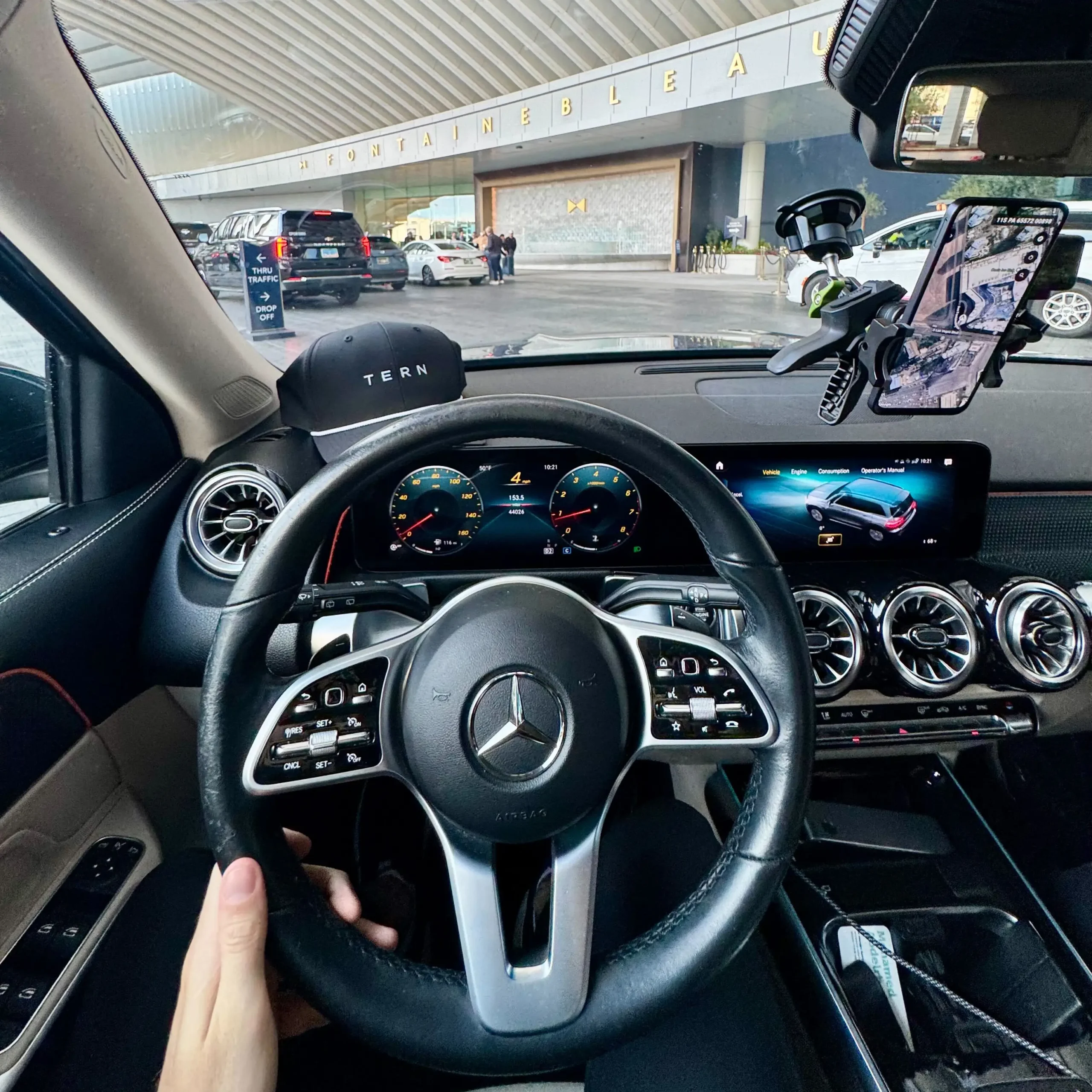
Instead of a booth, we invited thought leaders, executives, and innovators into a car navigated by TERN’s Independently Derived Positioning System (IDPS™). Over the course of the week, we hosted private demo drives with leaders from across automotive OEMs, Tier 1 suppliers, fleet and logistics platforms, mapping and navigation companies, silicon and software providers, and public safety organizations.
There were no slides and no simulations. IDPS™ ran live, on real roads, exactly as it would in the field. We repeatedly demonstrated the benefits of software-enabled positioning.
From Doubt to Demonstrated Capability
Most drives started the same way. Executives asked how the system initialized, what happened when GPS dropped, and how long it could run without correction. Many came in ready to challenge assumptions. That was expected.
But once the car started moving, those questions stopped coming up.
We switched off location services and relied entirely on IDPS™ for positioning. No signal. No satellites. Just software. Executives watched closely as positioning remained stable and continuous without faltering.
One executive summed it up quietly while we were still driving. “It’s binary. Either it works or it doesn’t. And this works.”
That reaction repeated itself across drives throughout the week.
What Actually Changed Minds
What surprised people most was not how accurate it was, but that it kept working.
Riders did not expect to see accurate, continuous positioning with location services turned off. That assumption surfaced early and quietly, often before the car even moved. The belief was simple and widely held. Without satellites or signals, positioning should degrade quickly or fail outright.
It did not. As one innovator put it, “Continuity is the hard part. And you solved that.”
Who We Drove With
The executives and innovators we demoed for came from very different industries, but the pattern of response was consistent.
We drove with automotive engineering and advanced R&D leaders, Tier 1 suppliers building next-gen autonomy and vehicle compute platforms, fleet and logistics executives managing large-scale deployments, mapping and location infrastructure providers, silicon and platform leaders shaping the software-defined vehicle stack, and public safety decision-makers.
Despite different use cases and priorities, the same realization surfaced quickly. This was not a lab concept or an early experiment.
“The baseline is clearly there. This isn’t hypothetical,” one executive said.
CES by the Numbers
By the end of the week, the results were unambiguous.
We completed 15 private demo drives. Without any signal or satellite, IDPS™ never lost positioning. Every demo ran from start to finish without interruption.
The consistency mattered more than any single moment.
When Evaluation Accelerated Into Integration
The shift toward integration was not unexpected. It happens often. What stood out at CES was how quickly it happened and how consistently it occurred across executives from very different segments.
Riders stopped observing the demo and started mapping it into their own systems. Questions moved rapidly toward compute footprint, integration paths, map layers, and deployment timelines.
One executive said it plainly. “I stopped watching the demo and started thinking about integration.”
Another described it as deployable rather than experimental. That distinction is difficult to earn.
“It truly is GPS grade positioning without GPS signal or hardware.”
Why CES Was a Proving Ground
CES was not a launch moment. It was another large-scale proving moment, across industries and business cases.
It confirmed that continuous, signal-independent positioning is no longer a future idea. It is something organizations need today to solve real operational problems. It also reinforced something we already believed. Some technology cannot be understood from a booth or a pitch.
It has to be experienced from the driver’s seat.
If you were not in the car at CES and want to experience this firsthand, we would like to hear from you.
Some technology does not need to be explained. It needs to be experienced.